“In light of CIL regulation 65(7) giving WBC full discretionary powers to withdraw CIL liability notices for whatever reason they see, can we now expect Waverley to amend its enforcement policy and adopt a more reasonable enforcement policy where it applies to home extensions and self-build homes ….similar to the approach West Berkshire have implemented?”
A : Cllr Liz Townsend, Portfolio Holder for Planning and Economic Development, responded in writing :
The resolution to the Motion that the Full Council considered at its meeting on the 28th January 2025 reads as follows
‘ that in line with West Berks households previously subject to CIL liability can request a discretionary review by the Council within a window from 1 June 2025 to 31st May 2026. For clarity, the Council has administered CIL in accordance with the CIL Regulation, which has been confirmed through the appeal process.
There is considerable work needed to set out a proposed discretionary Review process. The process will need to be considered and agreed upon by the Executive at its meeting on the 6th May 2025.
Bullet 5 of the Minutes of the 28th January 2025 reads Currently independent households that had been charged CIL were being reviewed. The process would need to go through a public consultation through the Local Plan currently with bids being examined once a year. This references three separate activities, which are: • We have a log of all householders that have been charged CIL and the triggers for that charging • There will be a separate working stream that will run to the timelines of the Local Plan review that will create the evidence to set a revised CIL Charging Schedule (this will be subject to its own Independent CIL Examination by an Inspector). • The Council has reviewed all the CIL bids received for this year and a report will be considered by the Executive at this meeting on the 1st of April 2025 to agree on how this year’s CIL will be allocated.
What is CIL.
The Community Infrastructure Levy (CIL) is a charge that local authorities can impose on new developments to help fund infrastructure needed to support that development, such as schools and transport, replacing the previous project-by-project negotiation system.
Here’s a more detailed explanation:
What it is:
A Planning Charge:
The CIL is a mandatory charge introduced by the Planning Act 2008, designed to ensure that development contributes to the infrastructure it relies upon.
Funding Infrastructure:
The money collected through CIL is used to fund infrastructure projects, including schools, transport schemes, and other community facilities.
Based on Floorspace:
The amount of CIL payable is based on the size and type of new floorspace created by the development.
Local Authority Responsibility:
Local authorities are responsible for setting the CIL rates and deciding how the funds will be spent.
Could the unthinkable happen? Cranleigh in Blackout?
The Cranleigh Society has done a fantastic job turning the spotlight on the area’s bleak future.
is Cranleigh a nd the nearby villages teetering on the edge of an energy abyss?
In nearby Alfold – the energy source has been going up and down like a see-saw for years.
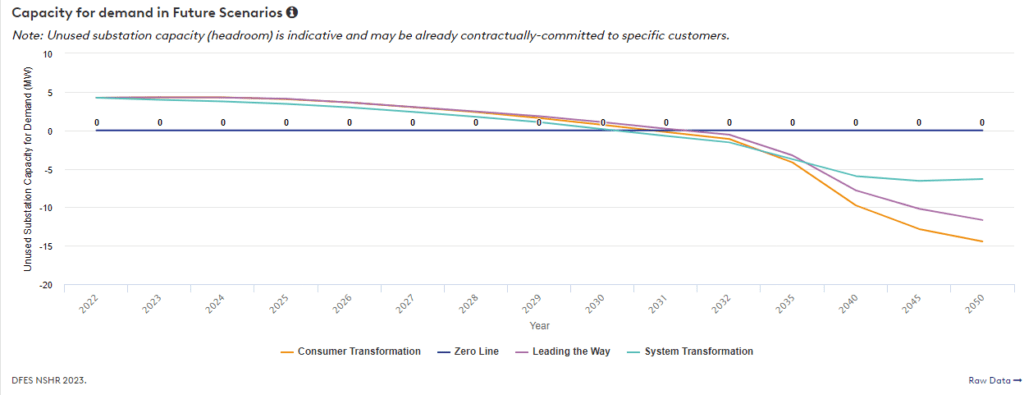
A once-reliable power infrastructure is buckling under monumental stress, being strained beyond capacity by relentless housing expansion and the insatiable demands of modern technology. Blackouts—once unthinkable loom larger with each passing day. Data extracted from UK Power Networks’ Open Data Portal paints a chilling picture:
Within five years, Cranleigh could face a future where the lights flicker and fail, plunging homes, businesses, and lives into darkness. Without swift, decisive action, the consequences could be dire.
UK Power Network’s Open Data Portal
The graph above, constructed from UK Power Networks’ data, lays the reality bare.
By 2031, Cranleigh’s energy infrastructure may have no headroom left—no spare capacity to absorb the growing demand.
This projection isn’t a vague hypothesis; it’s a stark warning derived from comparing current projects against four future development models, none offering a lifeline. The grid, already creaking under the weight of new homes and the electrification of daily life, is potentially close to buckling. Unless we act now, the village faces a future where power is no longer a given.
The Problems – A Perfect Storm
The roots of this crisis are as clear as they are alarming!
First, Cranleigh’s population is swelling. Waves of new housing developments, marketed as progress, have brought families, commuters, and retirees to the village, each new home plugging into an already overstretched grid. These aren’t just houses; they’re hubs of energy-hungry appliances, all drawing power at an unprecedented rate.
Note: Most new housing developments have been refused by Waverley planners but have been approved by government inspectors. EG Berkley Homes, the largest, was Government approved.
Second, modern technology has transformed how we live, work, and connect, but this technology demands a constant, reliable flow of electricity. Cranleigh’s infrastructure, much of it decades old, was never built for this. Substations and transformers are nearing their limits, and cables strain under peak loads. The Open Data Portal’s figures reveal a trajectory where demand outstrips supply by 2031, leaving no buffer for error—no room to weather a cold snap, a heatwave, or a surge in usage.
The consequences of this looming shortfall will be significantly damaging. Imagine a winter evening in Cranleigh: the kettle won’t boil, the heater stays cold, and the lights dim to nothing. Local businesses—our bakeries, shops, and cafes- shutter their doors, unable to operate ovens, tills, or Wi-Fi. For the elderly or infirm, reliant on powered medical devices, these blackouts aren’t an inconvenience—they’re a threat to life itself. Economically, socially, and personally, the harm will be profound.
This isn’t speculation; it’s a preview of a future barreling toward us. The UK has seen energy warnings before—National Grid’s tight margins in 2022 and 2023 hinted at what’s possible—but the stakes feel uniquely personal for Cranleigh. With its charm and history, our village risks becoming a cautionary tale: a place where growth outpaced foresight and the lights went out.
Solutions – A Call to Action
Yet this fate is not inevitable. The tools to avert this crisis exist—if we wield them with urgency and resolve. Cranleigh’s survival hinges on a multi-pronged strategy, blending immediate action with long-term vision. Here’s how we fight back.
1. Upgrade the Grid—Now UK Power Networks must act decisively to reinforce Cranleigh’s infrastructure. This means replacing ageing transformers, bolstering substations, and laying new distribution lines capable of handling higher loads. The Open Data Portal’s projections offer a roadmap: if headroom vanishes by 2031, we need capacity added years ahead of schedule. This isn’t cheap; upgrades could cost millions, and government grants or private investment will be needed. But to do nothing is no longer an option.
2. Smarter Demand Management We can’t just build our way out; we must manage what we have. Perhaps innovative grid technology, meters and systems that balance usage in real-time? Picture this: households get incentives to charge cars overnight or run appliances when demand is low, flattening the curve that threatens to overwhelm us. Businesses could adopt energy-efficient tech. It should not be about sacrifice but precision, ensuring power flows where and when needed most.
3. Local Power, Local Control Why rely solely on a distant grid? Cranleigh could harness its own energy. Solar panels on rooftops and a community microgrid could generate clean power right here, reducing the burden on Cranleigh’s Power and perhaps making it an exporter. These projects aren’t pipe dreams—villages like Fintry in Scotland have done it, cutting bills and boosting resilience. With council support and resident buy-in, Cranleigh could lead the way, turning a potential crisis into an opportunity.
4. Rein in Reckless Growth Elected officials and developers must stop treating housing as a free-for-all. Every new development should prove the grid can handle it. Planning permissions should focus and rely on energy assessments. If developers want to build, let them fund infrastructure upgrades—tie their ambitions to our reality. This isn’t anti-growth; it’s pro-sustainability, ensuring Cranleigh thrives.
5. Mobilize the Community This isn’t just a job for elected officials. It’s ours. Public pressure can force action. Village hall meetings, petitions and news articles can amplify our voice, demanding UK Power Networks and our Councils prioritise Cranleigh.
These solutions demand coordination, funding, and grit. UK Power Networks must lead but won’t move without pressure from above and below, government mandates and grassroots resolve. Time is our enemy; 2031 is closer than it seems.
The Choice is Ours
Cranleigh stands at a crossroads. One path leads to a situation where blackouts snuff out our daily lives. The other path offers hope, a future where bold action shores our grid, harnesses local ingenuity and balances growth with stability. The data from UK Power Networks isn’t a death sentence; it’s a wake-up call. By 2031, we could be a model of resilience or an example of the consequences of inaction.
The clock is ticking. Five years may sound distant, but infrastructure doesn’t bend to wishful thinking. Every month lost to indecision edges us closer to the brink. Our elected officials, from parish councillors to our MP, must champion this cause. Energy authorities must see Cranleigh not as a statistic but as a priority.
Cranleigh Society has also looked at other information from the Open Data Portal and prior regional development plans and provides access for you within this PDF– Here
This Table is taken from a Waverley Report.
This is part of how the council and government have put pressure on Cranleigh to solve its housing crisis. They have not thought through the problems. As we have all said, I do not know how many times, you need the infrastructure FIRST before the houses are built. The electricity, water, sewage, roads, schools, and doctors all need to be put in place before any building of homes is allowed. We have all said this, but why is no one listening?
Why are the utilities saying they can cope when clearly they cannot? Someone needs to tell this to all governments: You cannot keep increasing home building without increasing the capacity of the infrastructure FIRST.
Why not build a solar farm on Dunsfold? This appears to have come to a halt on the housing front, which would help provide electricity for Cranleigh and the surrounding area.
Why have none of the new houses in Cranleigh been built with Solar Panels and heat pumps? This should not have been allowed; it should have been part of the requirements. Putting these items in place at the build stage is far easier than adapting older houses.
I could go on and on about the inefficiency of planning departments, local government , and the Government. They are all to blame. We must stand up and tell them it is not good enough just to hope the problem will go away and make the country’s people suffer in this way. They are there to serve the people of the country and to carry out their wishes, not just do what they think will make them look good
Oops! M & S pulled out, too, and even Aldi doesn’t want the space?
After posting about the great Brightwells giveaway—a shop is offered for free for a year—we thought we would drop along to see just how “vibrant” the development really is. We almost fell off our Zimmer frame, so amused were we by the advertisement description as…
“one of Surrey’s most vibrant shopping and lifestyle destinations”.
On a busy Saturday, we counted about half a dozen people meandering about looking into the bare windows of the vast number of empty retail units. For the life of us, we couldn’t see the “vibrancy,” nor did it look like a lifestyle destination. All we could see wafting through Tory-led Surrey County Council’s flagship shopping development was tumbleweed! Lots of it.
As for its attempt to entice some independent business owners with a freebie—a retail unit rent-free for a year—how will that attract additional businesses? A single business retailer might be enticed to take advantage of the offer, but will one new business create enough additional footfall to attract additional retailers who will have to pay the full rent? If so, we will be pleasantly surprised.
The cinema needed a bung to move as it teetered on the edge of pulling out. Both Nando’s and Monte Forte found out and demanded an incentive. You cannot move to the centre of a town, particularly when it is deserted. Most flats have empty windows overlooking the complex and will likely stay so.
A London Council may take more properties to deal with their housing crisis.
Now motorists are queueing on Downing Street and elsewhere as part of Fanham’s Town Centre’s improvement works.
Rumour has it that the Bursar at TTC. has finally given in to Government and public pressure.
Why would we build houses there that nobody except the local council wants when we can help Gatwick expand? Said Richard Turnabout
With a little help from our friends in nearby Dunsfold village to extend the runway just a smidgeon, it could be up, up, and away, and hey ho, happy days for our college coffers as our cup runneth over with filthy lucre.
Life’s not all milk and honey these days for the country’s universities, you know! —it’s not milk and honey we are after; it’s milk and money. Chocks away, we say!
It all started when Aunty Rachel from Accounts said what she wanted – what she really really wanted, was to boost the economy with a third runway at Heathrow. But recently, things haven’t been looking so good there, so she wants a quick win, and where better than a second runway at Gatwick. It’s a long-held dream to use its emergency runway. But it does need just a little extra space elsewhere- and where better than nearby FoldDuns? It will undoubtedly boost the local economy of Arfold, as it is so often referred to by government inspectors who are eager to make Arfold the new Crawley with its very own Easy Jet base. “Destination Arfold,” here we come.
Peter Barker says: “GACC is launching a legal challenge of Gatwick Airport’s Emergency Runway Expansion. But the other Mr Barker, the local prolific barn-builder, says if there’s enough money in it for him, he will help the runway expand, and then he can then retire to his villa in the sun, his Chalet in the Alps, or even his condo in America. However, there may be another taker in the running.
I want Dunsfold Airport – it’s mine, I need it for security purposes, I want it, give it to me or I’ll cwy and cwy until cwap my pants
Hundreds, if not thousands, of planning applications bombard Waverley Borough Council’s planning portal yearly with applications to fell trees. Many are covered with Tree Preservation Orders.
Below are just a few in one week on WBC’s planning portal. On and on they go…
Here’s one getting ready for the chop in a Cranleigh garden. A neighbour said: ” I am in favour of removing this excessively overgrown tree. It blocks sunlight, causes root damage, and sheds huge amounts of fine debris that contribute significantly to blockages in rainwater drainage.
Planners and conservationists, including the arboricultural officer at Your Waverly, grapple with this knotty dilemma every day.
The illegal felling of mature trees never fails to shock, from the incomprehensibility of the Sycamore Gap vandalism to Plymouth Council’s felling of 100 mature trees under cover of darkness!
The outrage has shown that we are, at heart, a nation of tree lovers—and Waverley has one of the country’s most significant numbers of trees.
But do we care enough to stop the charge of the chainsaw?
Nature is paying a considerable price in the bid to build more homes—and how many fines have been handed out to all those Waverley residents who chop trees down just before a planning application is posted?
How many residents move into new homes where a developer has been forced to retain trees, and then applications go in to fell or remove huge sections once the leaves fall? We heard from one resident who bought a new home because the garden had a beautiful tree. Then, she realised the leaves had fallen and needed clearing up, and it was, in her words, “a real nuisance.”
TPOs are the primary means of protecting valuable trees. They are most common in urban and semi-urban settings and for trees with high amenity value.
Dozens of these appear weekly on the council’s planning Portal.




This is part of how the council and government have put pressure on Cranleigh to solve its housing crisis. They have not thought through the problems. As we have all said, I do not know how many times, you need the infrastructure FIRST before the houses are built. The electricity, water, sewage, roads, schools, and doctors all need to be put in place before any building of homes is allowed. We have all said this, but why is no one listening?
Why are the utilities saying they can cope when clearly they cannot? Someone needs to tell this to all governments: You cannot keep increasing home building without increasing the capacity of the infrastructure FIRST.
Why not build a solar farm on Dunsfold? This appears to have come to a halt on the housing front, which would help provide electricity for Cranleigh and the surrounding area.
Why have none of the new houses in Cranleigh been built with Solar Panels and heat pumps? This should not have been allowed; it should have been part of the requirements. Putting these items in place at the build stage is far easier than adapting older houses.
I could go on and on about the inefficiency of planning departments, local government , and the Government. They are all to blame. We must stand up and tell them it is not good enough just to hope the problem will go away and make the country’s people suffer in this way. They are there to serve the people of the country and to carry out their wishes, not just do what they think will make them look good