

Could the unthinkable happen? Cranleigh in Blackout?
The Cranleigh Society has done a fantastic job turning the spotlight on the area’s bleak future.

is Cranleigh a nd the nearby villages teetering on the edge of an energy abyss?
In nearby Alfold – the energy source has been going up and down like a see-saw for years.
A once-reliable power infrastructure is buckling under monumental stress, being strained beyond capacity by relentless housing expansion and the insatiable demands of modern technology. Blackouts—once unthinkable loom larger with each passing day. Data extracted from UK Power Networks’ Open Data Portal paints a chilling picture:
Within five years, Cranleigh could face a future where the lights flicker and fail, plunging homes, businesses, and lives into darkness. Without swift, decisive action, the consequences could be dire.
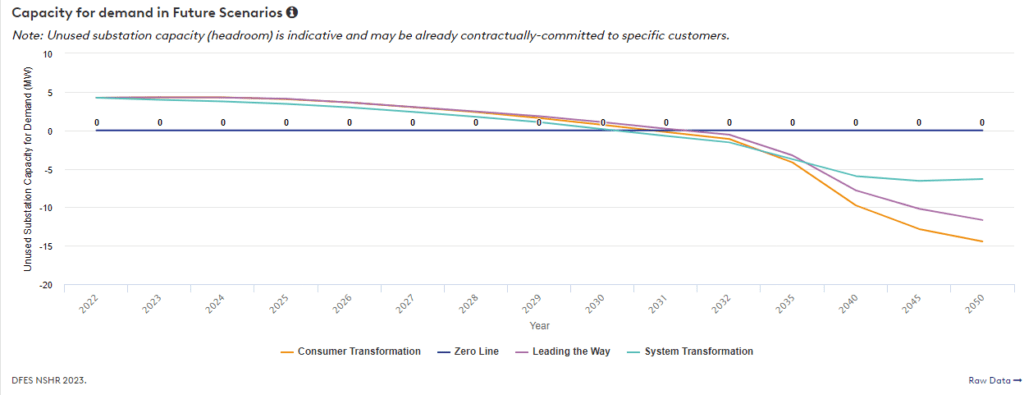
The graph above, constructed from UK Power Networks’ data, lays the reality bare.
By 2031, Cranleigh’s energy infrastructure may have no headroom left—no spare capacity to absorb the growing demand.
This projection isn’t a vague hypothesis; it’s a stark warning derived from comparing current projects against four future development models, none offering a lifeline. The grid, already creaking under the weight of new homes and the electrification of daily life, is potentially close to buckling. Unless we act now, the village faces a future where power is no longer a given.
The Problems – A Perfect Storm
The roots of this crisis are as clear as they are alarming!
First, Cranleigh’s population is swelling. Waves of new housing developments, marketed as progress, have brought families, commuters, and retirees to the village, each new home plugging into an already overstretched grid. These aren’t just houses; they’re hubs of energy-hungry appliances, all drawing power at an unprecedented rate.
Note: Most new housing developments have been refused by Waverley planners but have been approved by government inspectors. EG Berkley Homes, the largest, was Government approved.
Second, modern technology has transformed how we live, work, and connect, but this technology demands a constant, reliable flow of electricity. Cranleigh’s infrastructure, much of it decades old, was never built for this. Substations and transformers are nearing their limits, and cables strain under peak loads. The Open Data Portal’s figures reveal a trajectory where demand outstrips supply by 2031, leaving no buffer for error—no room to weather a cold snap, a heatwave, or a surge in usage.
The consequences of this looming shortfall will be significantly damaging. Imagine a winter evening in Cranleigh: the kettle won’t boil, the heater stays cold, and the lights dim to nothing. Local businesses—our bakeries, shops, and cafes- shutter their doors, unable to operate ovens, tills, or Wi-Fi. For the elderly or infirm, reliant on powered medical devices, these blackouts aren’t an inconvenience—they’re a threat to life itself. Economically, socially, and personally, the harm will be profound.
This isn’t speculation; it’s a preview of a future barreling toward us. The UK has seen energy warnings before—National Grid’s tight margins in 2022 and 2023 hinted at what’s possible—but the stakes feel uniquely personal for Cranleigh. With its charm and history, our village risks becoming a cautionary tale: a place where growth outpaced foresight and the lights went out.
Solutions – A Call to Action
Yet this fate is not inevitable. The tools to avert this crisis exist—if we wield them with urgency and resolve. Cranleigh’s survival hinges on a multi-pronged strategy, blending immediate action with long-term vision. Here’s how we fight back.
1. Upgrade the Grid—Now
UK Power Networks must act decisively to reinforce Cranleigh’s infrastructure. This means replacing ageing transformers, bolstering substations, and laying new distribution lines capable of handling higher loads. The Open Data Portal’s projections offer a roadmap: if headroom vanishes by 2031, we need capacity added years ahead of schedule. This isn’t cheap; upgrades could cost millions, and government grants or private investment will be needed. But to do nothing is no longer an option.
2. Smarter Demand Management
We can’t just build our way out; we must manage what we have. Perhaps innovative grid technology, meters and systems that balance usage in real-time? Picture this: households get incentives to charge cars overnight or run appliances when demand is low, flattening the curve that threatens to overwhelm us. Businesses could adopt energy-efficient tech. It should not be about sacrifice but precision, ensuring power flows where and when needed most.
3. Local Power, Local Control
Why rely solely on a distant grid? Cranleigh could harness its own energy. Solar panels on rooftops and a community microgrid could generate clean power right here, reducing the burden on Cranleigh’s Power and perhaps making it an exporter. These projects aren’t pipe dreams—villages like Fintry in Scotland have done it, cutting bills and boosting resilience. With council support and resident buy-in, Cranleigh could lead the way, turning a potential crisis into an opportunity.
4. Rein in Reckless Growth
Elected officials and developers must stop treating housing as a free-for-all. Every new development should prove the grid can handle it. Planning permissions should focus and rely on energy assessments. If developers want to build, let them fund infrastructure upgrades—tie their ambitions to our reality. This isn’t anti-growth; it’s pro-sustainability, ensuring Cranleigh thrives.
5. Mobilize the Community
This isn’t just a job for elected officials. It’s ours. Public pressure can force action. Village hall meetings, petitions and news articles can amplify our voice, demanding UK Power Networks and our Councils prioritise Cranleigh.
These solutions demand coordination, funding, and grit. UK Power Networks must lead but won’t move without pressure from above and below, government mandates and grassroots resolve. Time is our enemy; 2031 is closer than it seems.
The Choice is Ours
Cranleigh stands at a crossroads. One path leads to a situation where blackouts snuff out our daily lives. The other path offers hope, a future where bold action shores our grid, harnesses local ingenuity and balances growth with stability. The data from UK Power Networks isn’t a death sentence; it’s a wake-up call. By 2031, we could be a model of resilience or an example of the consequences of inaction.
The clock is ticking. Five years may sound distant, but infrastructure doesn’t bend to wishful thinking. Every month lost to indecision edges us closer to the brink. Our elected officials, from parish councillors to our MP, must champion this cause. Energy authorities must see Cranleigh not as a statistic but as a priority.
Cranleigh Society has also looked at other information from the Open Data Portal and prior regional development plans and provides access for you within this PDF – Here

This is part of how the council and government have put pressure on Cranleigh to solve its housing crisis. They have not thought through the problems. As we have all said, I do not know how many times, you need the infrastructure FIRST before the houses are built. The electricity, water, sewage, roads, schools, and doctors all need to be put in place before any building of homes is allowed. We have all said this, but why is no one listening?
Why are the utilities saying they can cope when clearly they cannot? Someone needs to tell this to all governments: You cannot keep increasing home building without increasing the capacity of the infrastructure FIRST.
Why not build a solar farm on Dunsfold? This appears to have come to a halt on the housing front, which would help provide electricity for Cranleigh and the surrounding area.
Why have none of the new houses in Cranleigh been built with Solar Panels and heat pumps? This should not have been allowed; it should have been part of the requirements. Putting these items in place at the build stage is far easier than adapting older houses.
I could go on and on about the inefficiency of planning departments, local government , and the Government. They are all to blame. We must stand up and tell them it is not good enough just to hope the problem will go away and make the country’s people suffer in this way. They are there to serve the people of the country and to carry out their wishes, not just do what they think will make them look good
And why is this a surprise, Waverley pushed ahead and built 2,000 housing knowing full well that water and power could not cope. We also know that there currently planning applications for hundreds more houses in Cranleigh. These bastards simply don’t care about the impact on the community
The sad fact is that Waverley Planners resisted much of the development inflicted on Cranleigh. Government Inspectors called the tune in the past and will do so in the future.
No doubt the new unitary authority will be fully prepared to meet the challenge.
Wind farm
Solar fields
All buildings fitted with solar. (Just think of the financial returns if churches were fitted with solar panels. Thinks Guildford cathedral would be a fantastic power station)
Battery banks
Pylons for import and export
Not the picture of rural that people are sold to move to Surrey. Certainly
not pretty. But a gas free means of keeping lights on and people moving.
Please note as WBC ceases to exist MM has no boundaries.
MM
I agree with your comment about infrastructure first. That was a big reason why very many people objected to the development of housing at Dunsfold Aerodrome. The big question is who is going to pay for the increased infrastructure for all the utilities and roads and schools NHS and hospitals. Builders and developers won’t want to do this before housing is built.
If the Local Planning Authority hadn’t consistently and irrationally screened out the need for Environmental Impact Assessments the Borough would not be in this tragic mess. The legal requirements for sustainable development has been ignored with impunity.
The startling fact remains that the planning lead for WBC is totally, completely, and utterly incompetent, and has presided over a cacophony of incompetence. Tiresome Townsend, and Feckless Follows really need their P45 as soon as physically possible once the nail is in the coffin of WBC.
You only have to look at the lack of engagement over any of the planning applications, their completely ineptitude in holding the developers to their S106 commitments, their abject failure to respect the wishes of the electorate, the residents.
Good riddance Tiresome Townsend
Get Lost Feckless Follows